
Multiband imaging
Multiband imaging refers to the combination of the results obtained through the use of different imaging techniques. Images of the same subject are acquired and combined over different spectral ranges (spectral bands as wide as hundreds of nanometers) by means of specific imaging and illumination systems.
The multi-band imaging techniques used for the study of purple and illuminated codices consisted of visible (Vis), basically aimed at documenting the work of art and its details, photographic infrared (IR), false color infrared (IRFC) and luminescence induced by ultraviolet radiation (UVL) imaging methods.
The two infrared techniques allow obtaining information on the materials underneath the surface of the materials. The extent of the scattering of the incident radiation by the material decreases as its wavelength increases, resulting in a decrease in the covering power and a consequent greater transparency of the surface layer. This fact allows the visualization of underdrawings, as well as the possibility of highlighting pentimenti and in paintings.
An IRFC image is a combined post-process image of the IR and VIS images, in which the IR information takes the place of the red channel, and the red and green ones are shifted to the green and blue channels, respectively. This makes it possible to highlight pigments or mixtures with the same color in the visible, but with a different chemical composition.
 |
 |
 |
 |
|
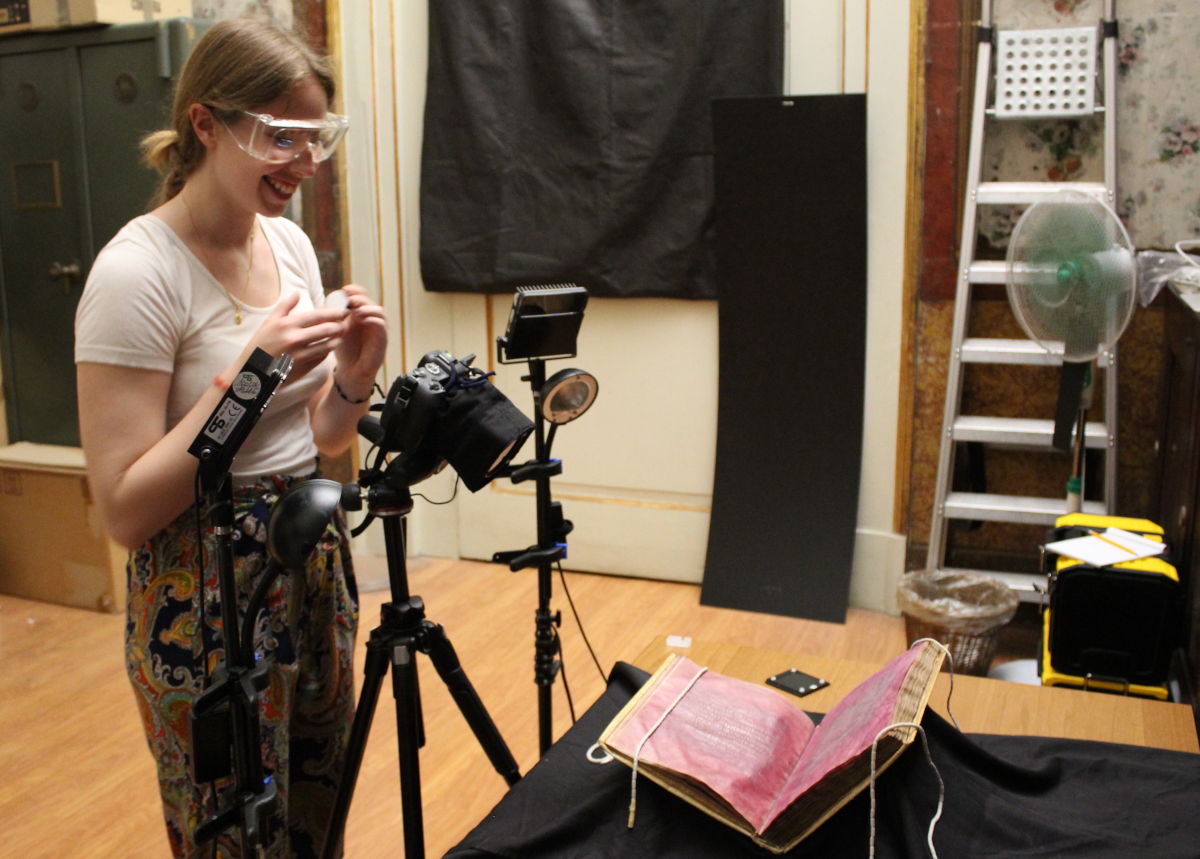
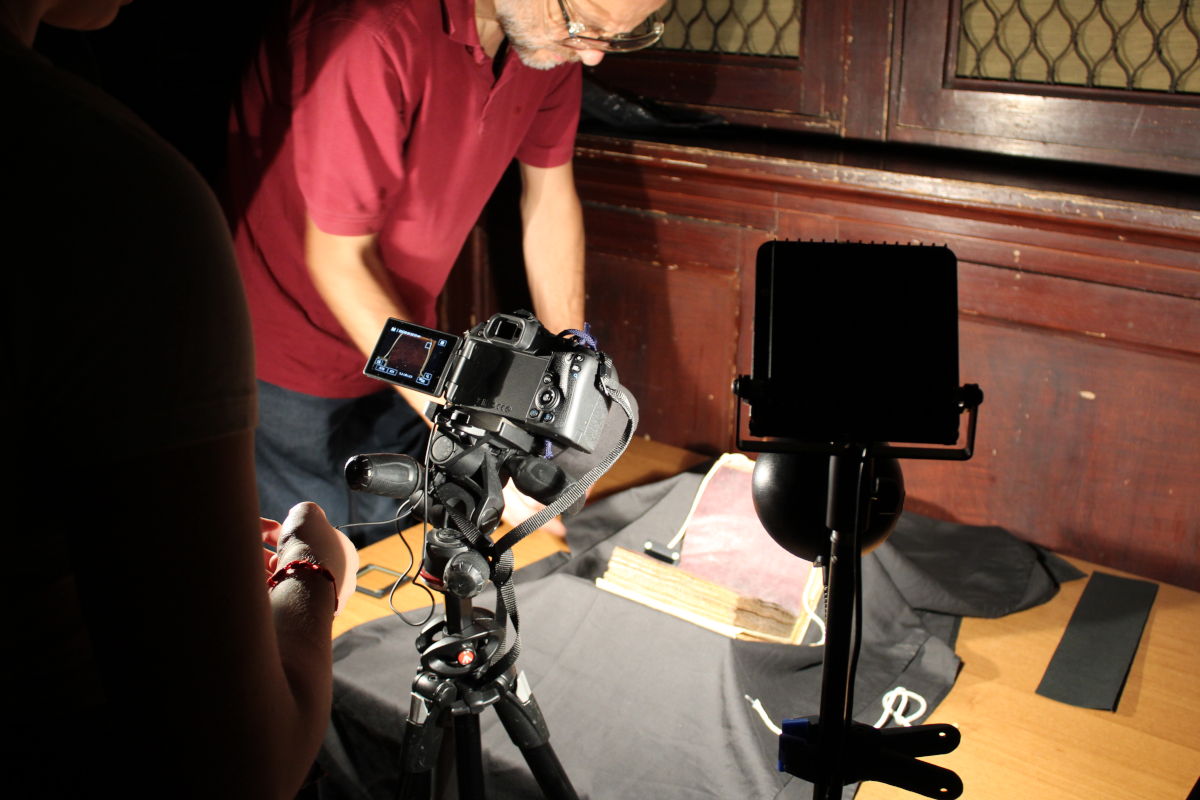
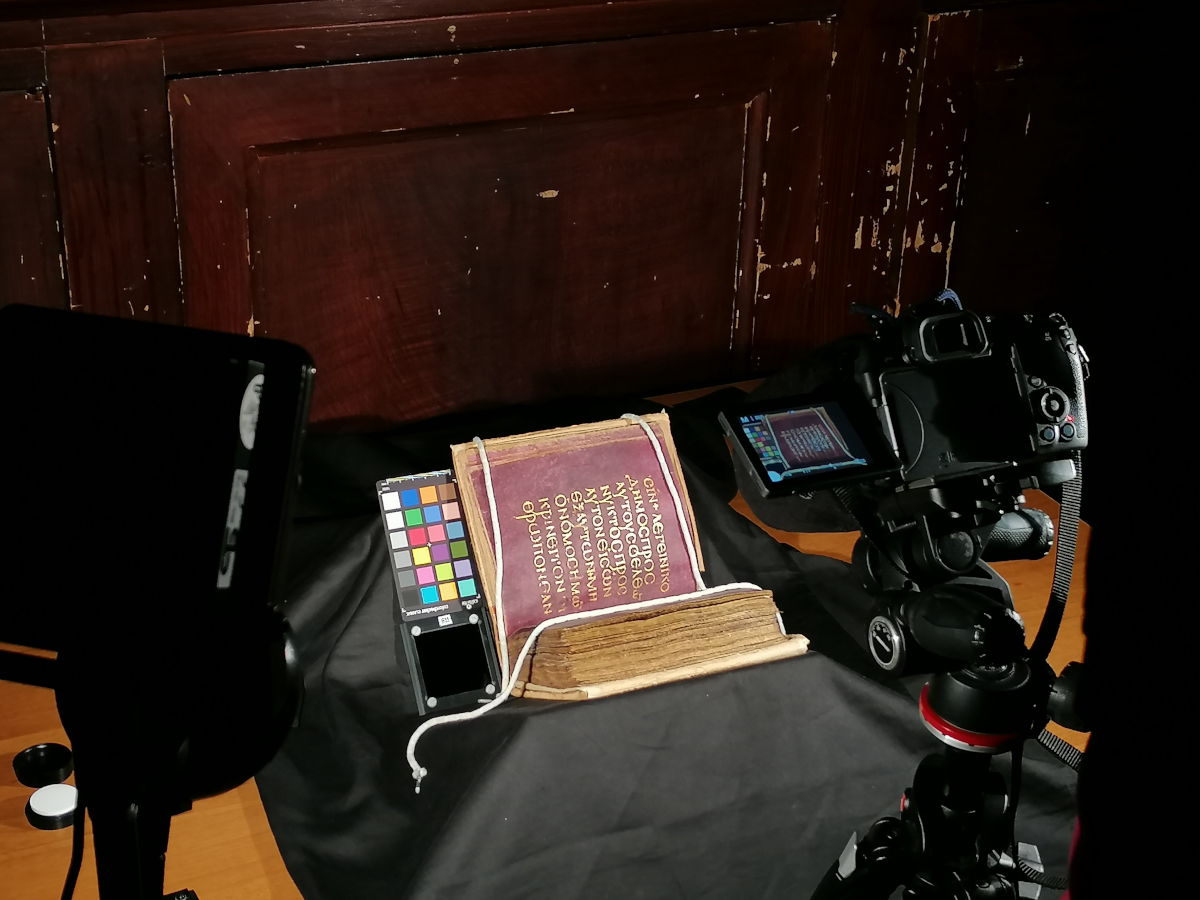
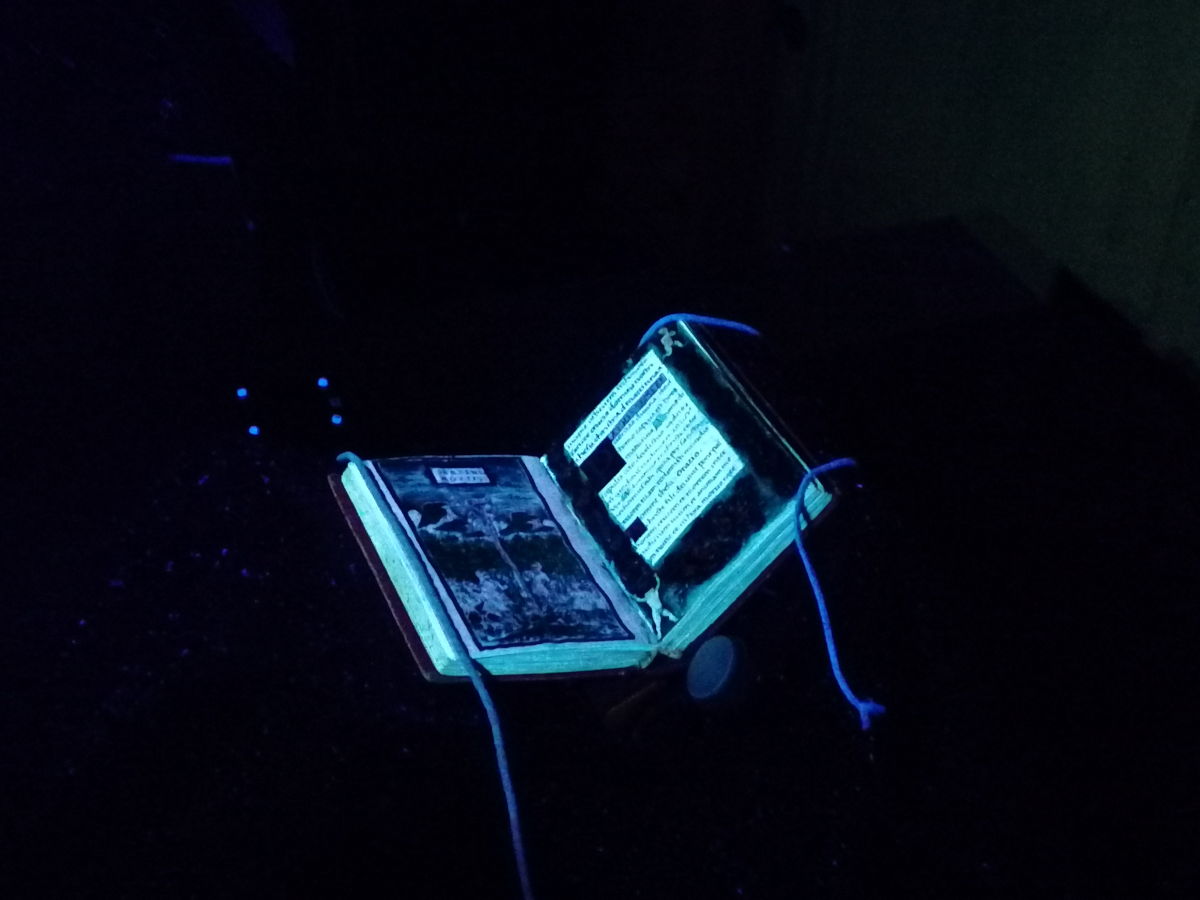
Multiband imaging setup at the Biblioteca Nazionale Vittorio Emanuele III of Naples |
Ultraviolet-induced visible luminescence (UVL) images are obtained by recording the emission of the visible radiation (400–700 nm) when the object is illuminated by UV. The peculiarity of emitting light once illuminated by a UV source is peculiar of specific materials, such as binders, pigments and dyes (i.e. zinc oxide and red lakes), as well as varnishes, coatings, and adhesives. UVL images provide information on the differentiation and mapping of materials that cannot be distinguished by the naked eye and, in some cases, allows their identification.
Multiband imaging data were obtained using a Canon EOS RP mirrorless digital camera with an approximately 26.2-megapixel full-frame silicon CMOS sensor equipped with an EF 50 mm f/1.8 STM lens. The camera was modified to cover the 360 to 1100 nm spectral range (Fig. 1).
For this study, two 50 W halogen lamps, with a color temperature of approximately 3200 K, were used for Vis and IR acquisitions. For UVL technique a pair of LED lamps model CTS ART LUX 100LW, modified at CNR-IFAC with the addition of a UG11 filter to eliminate the visible parasitic component, were used.
A Kolari Vision UV/IR Cut Hot Mirror Pro 2 filter was used for capturing the visible images to compensate for the removal of the IR filter located in front of the camera sensor on the camera. For capturing the UV luminescence, in addition to the Kolari Vision UV/IR Cut Hot Mirror Pro 2 filter, an Asahi Spectra Filter / UV 422nm 50x50mm was also used to cut off the UV component reflected from the surface. Finally, to acquire the IR images, a bandpass filter was placed in front of the lens to pass only the IR radiation while cutting off the visible radiation. Specifically, the 850 SCF-50S-85IR BLlck filter from OptoSigma® Europe was used, which allows only radiation above 850 nm to be recorded.
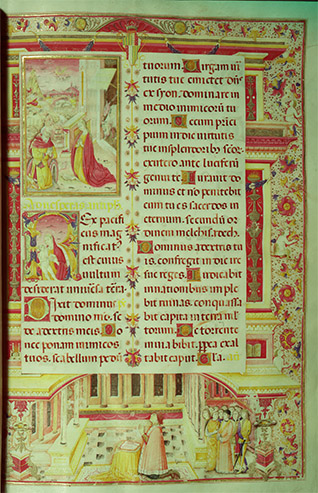
FC-IR image of the Ferrante Breviary (Biblioteca Nazionale Vittorio Emanuele III of Naples). |
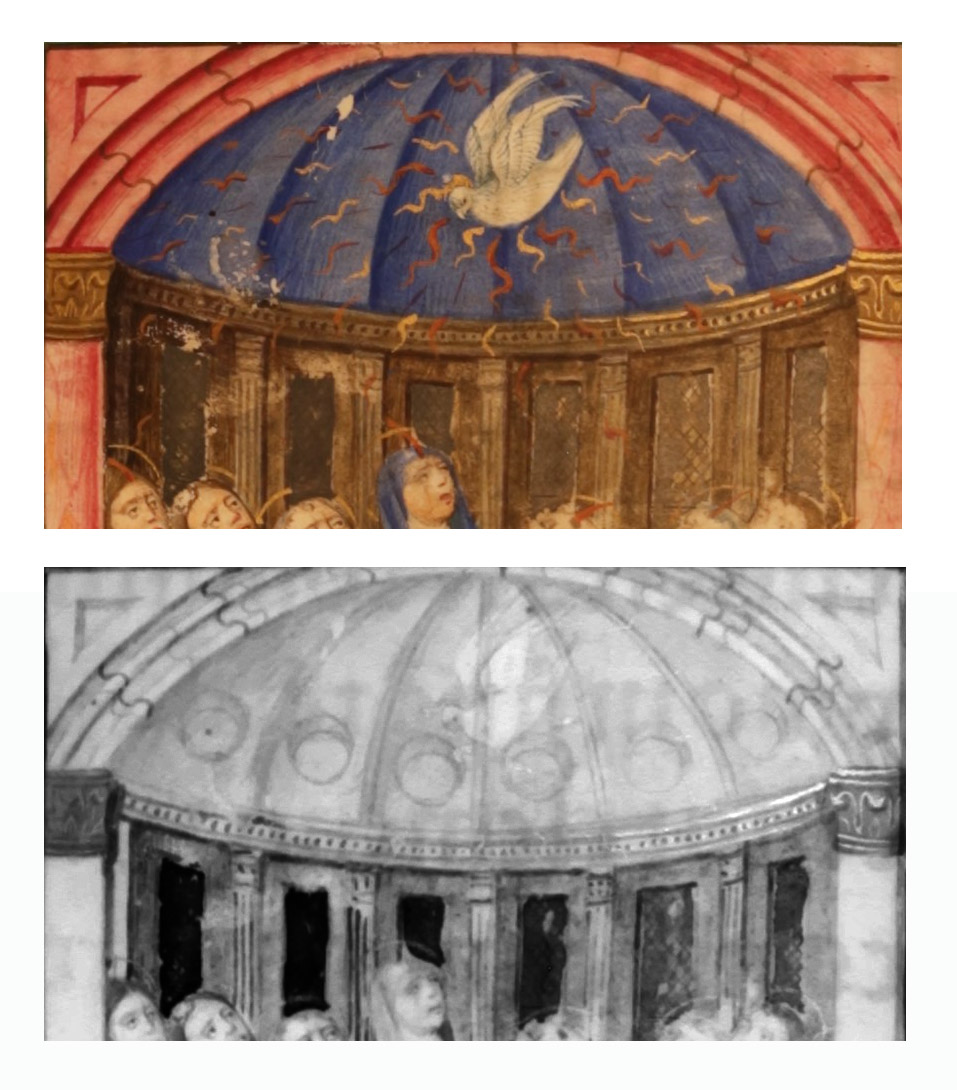
RGB and IR images of a particuar from the The Ferrante Breviary (Biblioteca Nazionale Vittorio Emanuele III of Naples). |
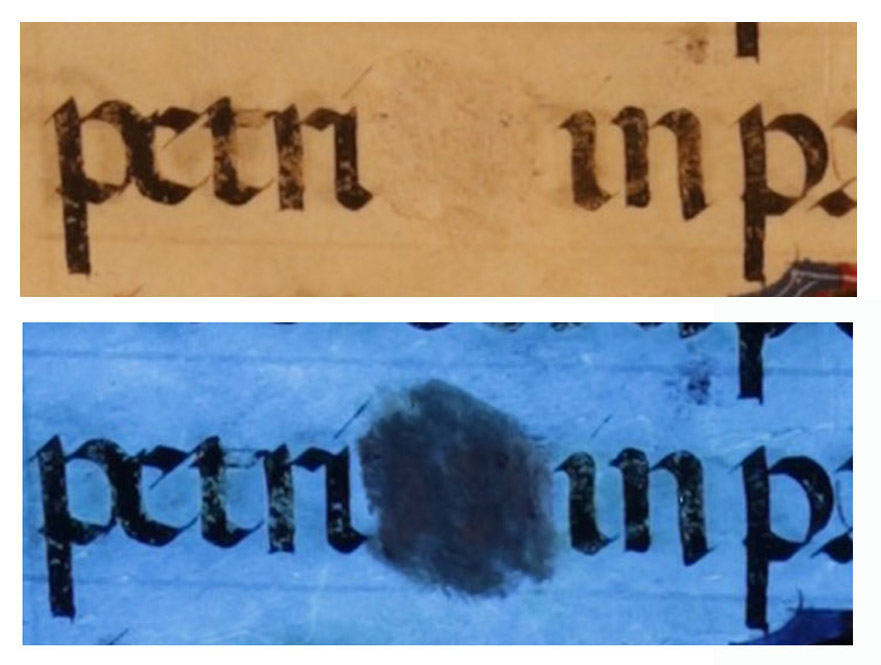
UV and RGB images from the Ferrante Breviary (Biblioteca Nazionale Vittorio Emanuele III of Naples). |
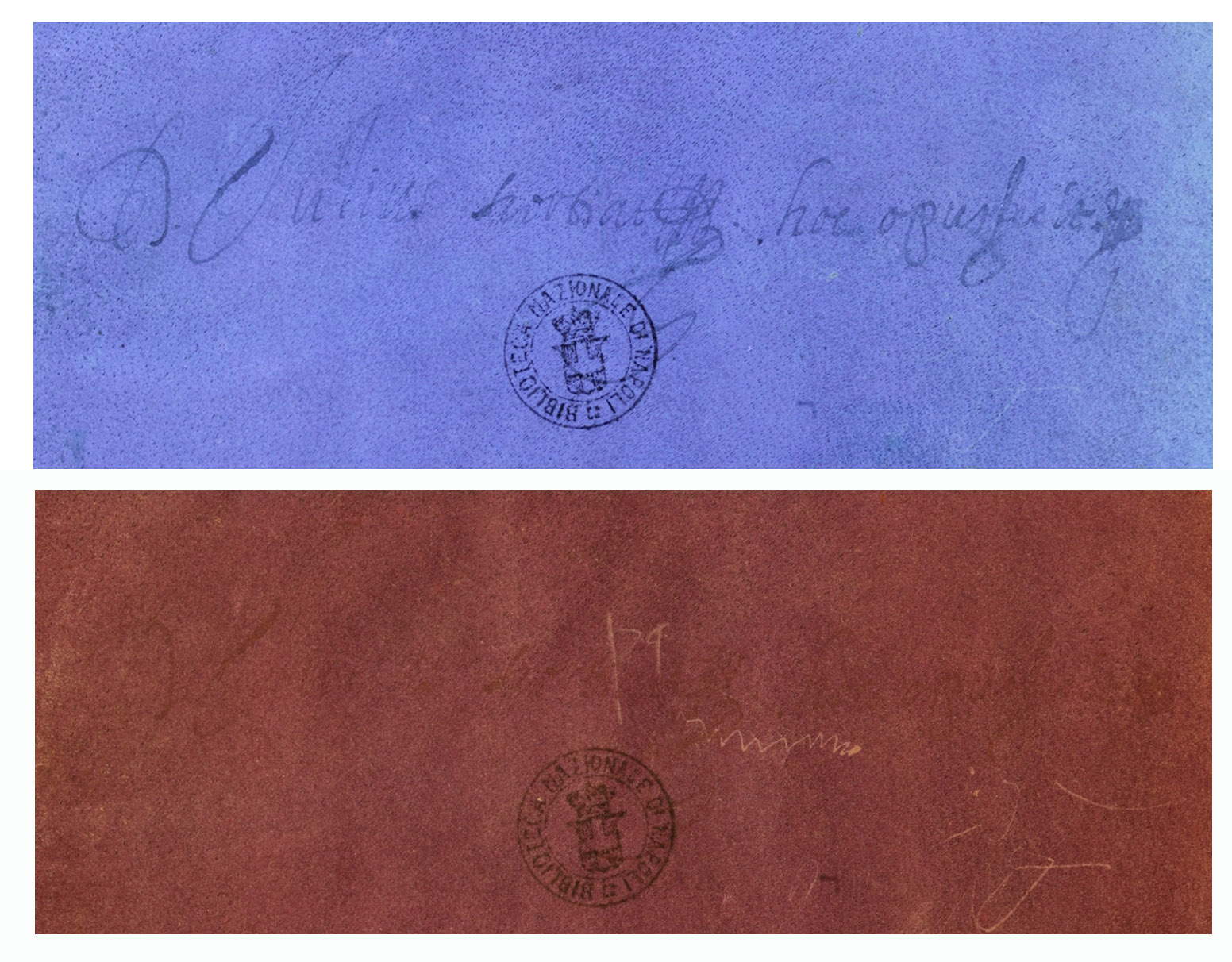
UV and RGB images of the Plutarco,Heroum clarissimorumque virorum divinae (Biblioteca Nazionale Vittorio Emanuele III of Naples). In the UV image it is possible to observe the inscription D.(ominus) Julius Scortia(tis) hoc opus fecit. |
References
- Aldrovandi A., Picollo M., 2007. Metodi di documentazione e indagini non invasive sui dipinti, Padova, Il prato, (II edizione)
- Bartolozzi, G., Casini, A., Castelli, L., Cucci, C., Grazzi, F., Mazzinghi, A., Pieralli, I., Ruberto, C., Sarfati, R., Sidoti, A. and Stefani, L., 2024. The Non-Invasive Spectroscopic Study of a Parchment Object from the National Central Library of Florence: The Hebrew Scroll. Heritage, 7(1), pp.206-224.
- Cucci, C., Delaney, J.K. and Picollo, M., 2016. Reflectance hyperspectral imaging for investigation of works of art: old master paintings and illuminated manuscripts. Accounts of chemical research, 49(10), pp.2070-2079.
- George, S., Hardeberg, J.O.N.Y., Linhares, J., MacDonald, L., Montagner, C., Nascimento, S., Picollo, M., Pillay, R., Vitorino, T. and Webb, E.K., 2018. A study of spectral imaging acquisition and processing for cultural heritage. Digital Techniques for Documenting and Preserving Cultural Heritage, pp.141-158.
- MacDonald, L.W., Vitorino, T., Picollo, M., Pillay, R., Obarzanowski, M., Sobczyk, J., Nascimento, S. and Linhares, J., 2017. Assessment of multispectral and hyperspectral imaging systems for digitisation of a Russian icon. Heritage Science, 5, pp.1-16.